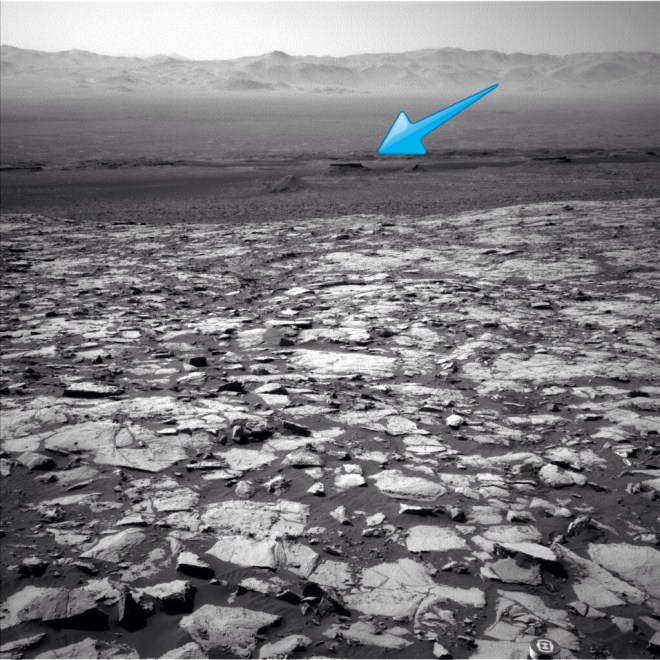
While studying some new photos from Mars I have found this interesting one. You can see a flat top hill that resembles some locations on Earth.
These flat top hills looks like small mesas, butes or some kind of table mountains. But these terrain features are very interesting anyway.
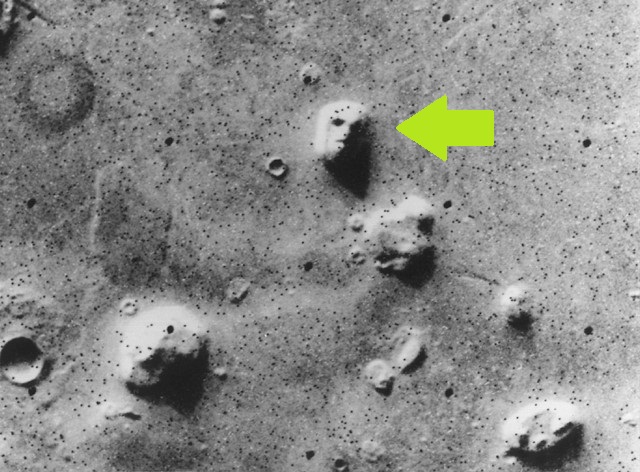
A few decades ago, there was some similar formations found in Cydonia location on Mars. Maybe you can remember the famous “face on Mars” that made some people thinking that there must have been some aliens on Mars! But of course, this “face” formation was later explained as a natural land-form:
NASA’s Viking 1 Orbiter spacecraft photographed this region in the northern latitudes of Mars on July 25, 1976 while searching for a landing site for the Viking 2 Lander. The speckled appearance of the image is due to missing data, called bit errors, caused by problems in transmission of the photographic data from Mars to Earth. Bit errors comprise part of one of the ‘eyes’ and ‘nostrils’ on the eroded rock that resembles a human face near the center of the image. Shadows in the rock formation give the illusion of a nose and mouth. Planetary geologists attribute the origin of the formation to purely natural processes. The feature is 1.5 kilometers (one mile) across, with the sun angle at approximately 20 degrees. The picture was taken from a range of 1,873 kilometers (1,162 miles). Image credit: NASA/JPL-Caltech
Dr. Jozef Kozár is a scientist and writer, studying planets, Solar System, and robotic space exploration missions. He is the author of seven books, author of several hundred articles published in various scientific and popular magazines, a former public speaker, and a documentary movies/TV guest.
Jozef's Mars research and the “GNSS for Mars” project became well known especially in 2015 when it attracted many local and worldwide media. Jozef earned his Ph.D. in the field of aerospace from the Technical University of Kosice in 2016. During his following career, he left his home country and completed a professional university course in planetary science – the science of the Solar System, at the California Institute of Technology (Caltech), Pasadena, California in 2019. View all posts by Joe


 Planetary Science Blog